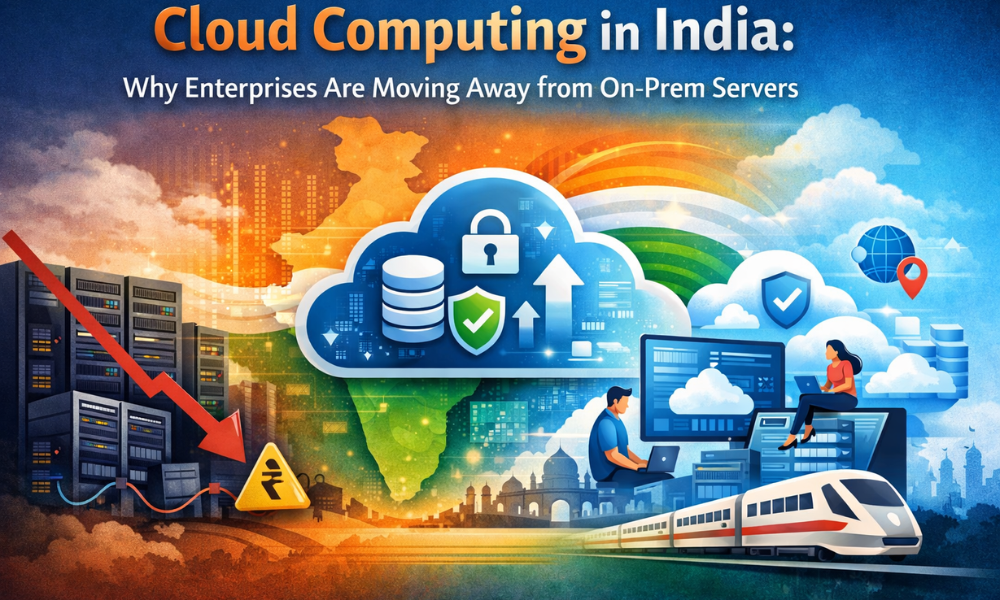
Cloud Computing in India: Why Enterprises Are Moving Away from On-Prem Servers
Introduction
Cloud computing is transforming the way Indian businesses manage their IT infrastructure. The increasing cost of operations, growing demands for data, and the need for rapid innovation are making on-premise servers less flexible and more costly. Cloud computing provides flexible, secure, and economical solutions that are more aligned with the needs of the business. The increasing pace of digital transformation is driving Indian businesses to make the strategic move to the cloud.
Cost Efficiency and Scalability: The Largest Motive for Cloud Adoption
The main reason why Indian businesses are shifting away from on-prem servers is the cost associated with the use of on-prem servers. On-prem servers involve high capital expenditure on hardware, data centres, power consumption, cooling systems, and IT personnel. Cloud computing, on the other hand, is based on the pay-as-you-use principle. This helps businesses in minimizing capital expenditures and turning them into operational expenditures. This is particularly helpful for startups and large businesses that have fluctuating workloads. Cloud computing also provides instant scalability to businesses. Businesses can scale up or down depending on their requirements without having to purchase new hardware. This ensures optimal resource utilization and prevents over-provisioning. For Indian businesses, cloud computing provides a significant advantage over on-prem infrastructure due to its cost efficiency and scalability.
Security, Compliance, and Data Localization in the Indian Context
The security and compliance challenges around data that hindered cloud adoption in India in the past have shifted considerably. In fact, as a result of this shift, enterprise-level cloud service providers now have added enterprise-level security features, such as encryption, identity management, continuous monitoring, and threat detection; more importantly, they are compliant with Indian data security regulations imposed by the Reserve Bank of India (RBI), Securities and Exchange Board of India (SEBI), and Ministry of Electronics and Information Technology (MeitY). With the establishment of data centres located in India, the issue of data localisation is no longer relevant because the cloud provider’s sensitive business information and customer data can be stored inside India’s borders. Cloud providers also typically undergo regular audits and certification processes that many enterprises are unable to complete because of the time and costs associated with maintaining the level of security and compliance necessary to maintain a viable enterprise environment. As a result, today there are strong security benchmarks, and compliance qualifications available on cloud platforms than there are on traditional on-premise servers in the banking, healthcare, and telecommunications industries.

Business Agility and Faster Time-to-Market.
The need for speed and agility in businesses has become a critical factor in their success due to the growing emphasis on the digital economy. As organisations move towards procuring infrastructure in data centres/systems using physical hardware this process can often take a significant amount of time and significantly impact the organisation’s ability to innovate, as it also requires manual configuration of a majority of systems prior to deployment or use. Conversely, with a cloud computing provider organisation can eliminate these bottlenecks by being able to provision resources in a matter of minutes. As a result, boards can approve development efforts and the development teams are able to use cloud-native tools and DevOps principles to quickly test, deploy and scale their applications. Therefore, organisations will significantly reduce their time-to-market for new products and services.
In recent years Indian organisations have embraced the cloud in areas such as fintech, eCommerce, and SaaS; and are using cloud platforms to develop new products quickly, through experimentation and then deploying them to meet customer requirements faster than ever before. Furthermore, through cloud automation and managed services, organisations can maximise their productivity by relying less on large IT teams, thus allowing them to focus more on innovation/growth than on managing their infrastructure.
Robustness, Disaster Recovery, and Remote Workforce Enablement
For on-premises data centers, reliable business continuity is always a critical issue, especially in India, where blackouts and environmental disasters can be common. In contrast, cloud technologies can provide inherent redundancy, near-zero downtime, and automatic backups across multiple data center geographies.
Therefore, cloud solutions can provide faster disaster recovery than traditional methods while offering lower costs than maintaining redundant on-premise environments. Also, as more employees move to hybrid work environments or work-from-home setups, an increasing number of companies have a greater need for 24 / 7 access to their systems and data. Cloud-based solutions will ensure that employees working remotely have secure access to the company’s applications regardless of their location; as a result, they can continue to be productive, collaborative, and effective employees.
Cloud computing has become indispensable for all Indian enterprises that have adopted flexible working models and require reliability, redundancy, and workforce enablement.
Conclusion
Cloud computing has emerged as a necessity for Indian businesses, rather than a mere technology upgrade. The obvious advantages of cloud computing in terms of cost optimization, security, agility, and reliability make it much more adept at dealing with the rapidly changing business environment. As the digital transformation trend continues to intensify across various sectors, the trend of moving away from on-prem servers is likely to gain momentum, and cloud computing is expected to be a major growth driver for Indian enterprises.