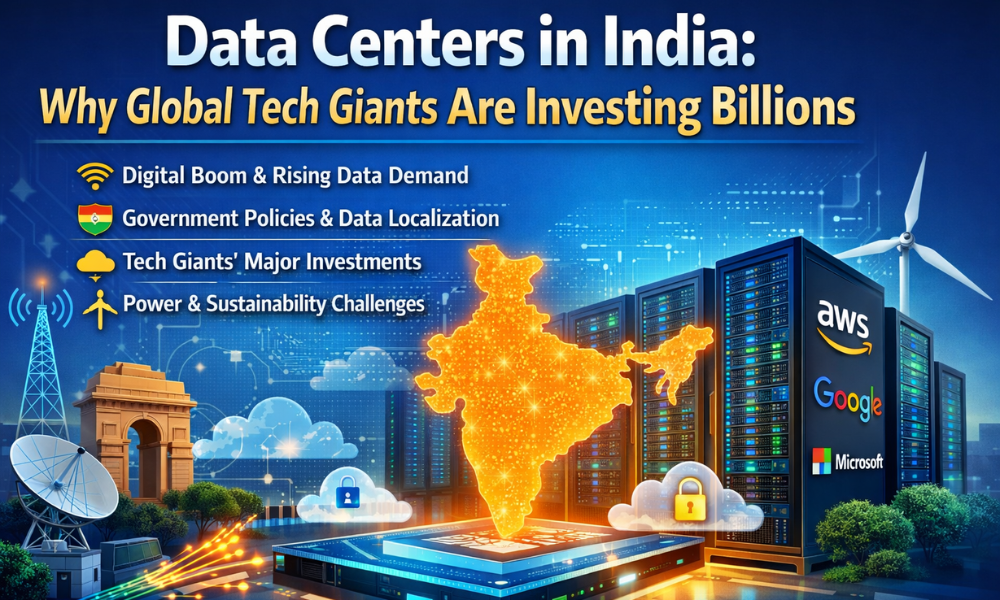
Data Centers in India: Why Global Tech Giants Are Investing Billions
Introduction
Data centres in India are becoming a popular place for investment with a rapidly increasing amount of treaties between companies looking at moving their data centres to India and wanting to invest in data centres in India and with more digital consumption. As global technology companies from around the world have invested billions of dollars to build large networks of data centres across India, there are many reasons that are making India a world-class data centre hub – such as government policies that are friendly to businesses, as well as a digital economy that is growing very rapidly.
The Exploding Digital Demand in India: The Primary Catalyst for Data Center Growth
The primary catalyst for data center growth in India is the exploding digital demand in the country. With more than 800 million internet-savvy citizens, increasing smartphone adoption, and affordable data plans, the country is producing an enormous amount of data on a daily basis. The fintech, e-commerce, OTT platforms, online gaming, and digital payment industries are dependent on cloud infrastructure to support their operations at a massive scale. The adoption of 5G networks and the growing use of AI, IoT, and big data analytics are further fuelling data consumption. Businesses are also migrating from traditional IT infrastructure to cloud-first strategies, thereby creating a need for data storage and processing infrastructure. As businesses require low-latency services and real-time data access, regional data centres have become essential. The exploding digital demand in India makes it one of the fastest-growing data center markets in the world.
The Role of Government Policies And Data Localization In Developing A Favorable Investment Environment
Government investment has been very important in drawing in foreign investments into data centers in India. The various government programs Digital India, Smart Cities, and Make in India have greatly assisted in improving the digital infrastructure of the country. The requirement for data localization has developed the need for companies to create local (within India) data centers, rather than relying on data storage facilities located outside the country. Many of the states such as Maharashtra, Tamil Nadu, Telangana and Uttar Pradesh have established formal policies for the creation of data centers, and offer incentives for creating a local data center such as tax incentives, quicker approval processes and subsidized power. Improvements to the ease of doing business in these states and to the infrastructure and connectivity of these states have all contributed to the increase in the level of confidence that investors have in regards to establishing a data center in India. With the creation of these policies, investors in India can rely on a consistent set of regulations over the long term and create an attractive business environment for large, capital-intensive data center projects by large international technology companies.

Why Global Tech Giants Are Betting Big on India’s Data Center Ecosystem
Because of India’s tremendous growth potential, worldwide technology firms like Amazon Web Services, Microsoft Azure, Google Cloud, and Meta are investing billions of dollars in India’s data center ecosystem. India has the unique ability to combine scale, cost efficiency, and growth potential over time. There will continue to be high demand for cloud services among companies (including startups), as well as government agencies, as India’s digital economy continues to grow. In addition, due to the lower cost of land and labor compared to mature markets, it is more feasible for global enterprises to deploy on a large scale. Building local data centers allows global enterprises to provide quicker service, comply with local regulations, and develop confidence with Indian customers. For the technology giants, India is a strategic growth market that can also serve as a regional hub for their global growth. These investments signal the enormous amount of faith that global technology companies have in India’s digital future and commitment to adopting cloud technology.
Opportunities & Challenges: Power, Sustainability, and the Future
The future of India’s data centres is bright, with good growth potential; however, many challenges around power supply and sustainability create several issues for our industry. Data centres are large users of electricity and require a continuous supply of electricity, which will be a major issue for data centre operators today. Data centres also pose large environmental challenges due to their extensive use of cooling systems, water, and carbon emissions. However, while the above issues will be a challenge, they can also present large opportunities. Many data centre operators are beginning to invest in renewable energy sources such as solar and wind power to supply their facilities’ energy needs. Innovations in energy-efficient cooling technologies and green data centre designs are also gaining popularity among data centre operators. With a growing focus on sustainability and ESG goals, India could become a leader in developing green data centres. The successful management of these challenges will help to define future growth and global competitiveness of India’s data centre industry.
Conclusion
The emergence of India as a global destination for data centers is being fueled by a potent combination of digital expansion, an encouraging government policy framework, and interest from global technology leaders. With data consumption set to continue its growth trajectory and companies adopting a cloud-first approach, the demand for robust infrastructure is only set to increase. Although issues related to power and sustainability continue to be a challenge, they also present opportunities for innovation and sustainable investments. The fact that billions of dollars are being invested in the sector is an indication of long-term faith in India’s digital future.