New Year’s Eve Strike Shakes India’s Gig Economy: Swiggy, Zomato Workers Demand Fair Pay & Safety
Introduction
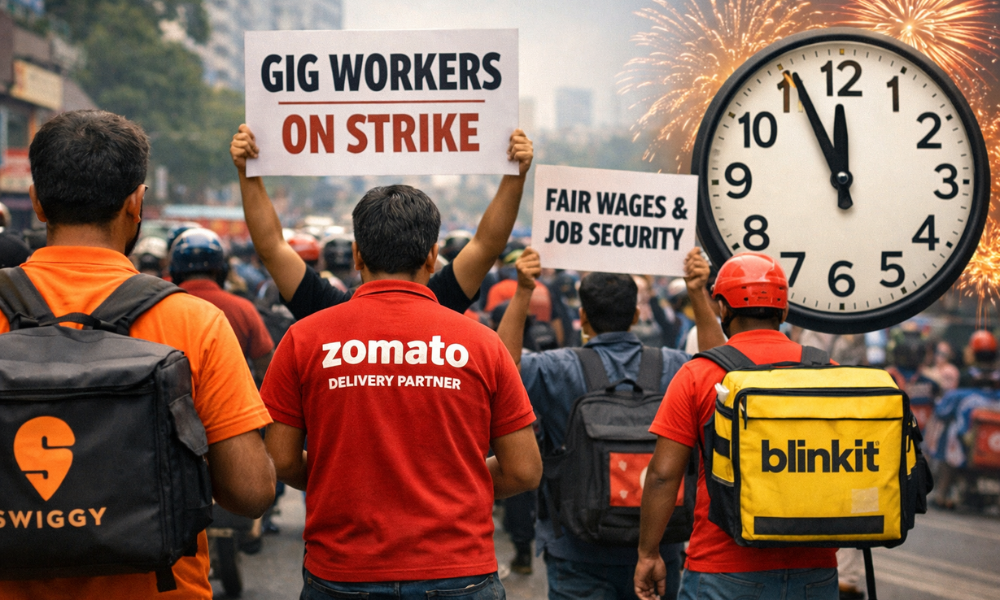
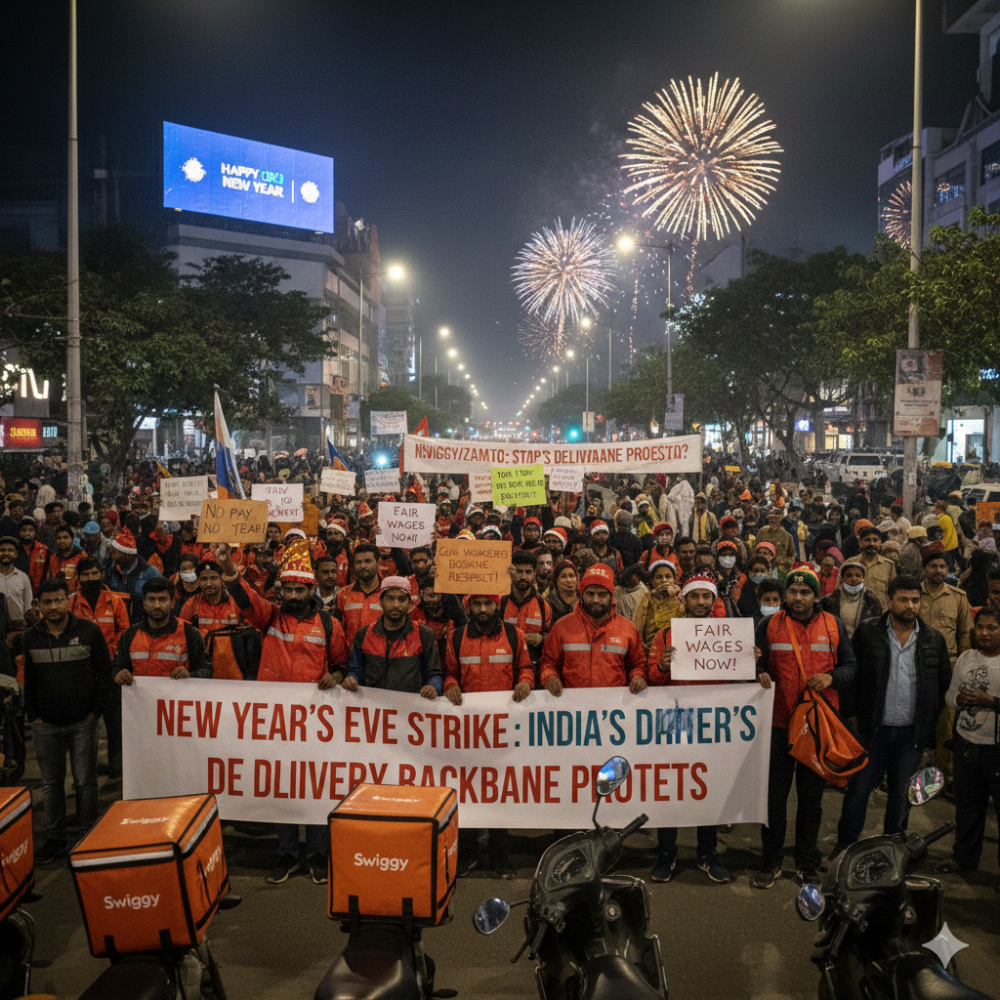
As India ushered in 2026, the night before—New Year’s Eve—was marked not by smooth food and grocery deliveries but by protests and a nationwide strike called by gig workers across the country. Delivery partners associated with major platforms like Swiggy, Zomato, Blinkit, Zepto, Amazon and Flipkart took part in a coordinated action, logging out of apps and demanding long-overdue changes to the work model that underpins India’s digital delivery ecosystem.
Why the Strike Happened
Gig workers are the backbone of India’s booming on-demand delivery economy, fulfilling millions of food, grocery and e-commerce orders every day. Despite this, workers say their earnings have dwindled, workloads have intensified, and basic protections are missing. The strike on December 31, 2025 was not spontaneous; it followed mounting frustration over several key issues:
- Falling Earnings and Opaque Pay Structures
Delivery partners are typically classified as “independent contractors”, meaning they are paid per delivery rather than a fixed salary. Over time, per-order payouts have declined even as fuel costs, vehicle maintenance and living costs have risen. Workers report that after expenses they are often left with barely a few hundred rupees — far below a sustainable income level — despite long working hours.
- Dangerous Ultra-Fast Delivery Targets
One of the most controversial demands of gig workers is the elimination of 10-minute delivery promises. These ultra-fast targets are marketed to consumers as a competitive feature, but workers argue they incentivize reckless riding, increase accident risk, and put lives at risk just to hit algorithm-generated deadlines.
- Lack of Social Security and Worker Protection
Unlike traditional employment, gig workers generally have no paid leave, health insurance, accident protection, pension or other basic social security benefits. Calls for gig workers to be legally recognized and covered under formal labour laws have grown louder in recent years.
- Arbitrary Account Blocking
Workers have also protested against sudden app account deactivations without meaningful appeal or explanation. For many gig workers, losing access to their delivery app is equivalent to losing their job.
- Right to Organize and Bargain
A core demand of the strike was official recognition of gig workers’ right to organize and to engage in collective bargaining with platforms. Unions like the Indian Federation of App-Based Transport Workers (IFAT) and the Telangana Gig and Platform Workers Union (TGPWU) have been at the forefront of mobilizing delivery partners.
What Happened on New Year’s Eve
Union organizers estimated that over two lakh (200,000+) delivery workers participated in the strike by logging off from their delivery apps from early morning until midnight — though the exact level of participation varied by city.
Despite the strike call, many workers stayed online due to incentive offers from platforms. Swiggy and Zomato increased payouts and incentives for New Year’s Eve peak hours in an attempt to ensure minimal service disruption during one of the busiest nights of the year.
Platforms defended their performance: Zomato’s leadership claimed that over 75 lakh (7.5 million) orders were delivered and that the disruption was limited, crediting the efforts of delivery partners who continued to work. But unions rejected this narrative, saying high delivery numbers only reflect workers’ desperation to earn, not fairness of the system.
In some cities like Bengaluru, Hyderabad and Delhi, delivery slowdowns and shortages were reported, while in others the impact was less visible — highlighting the partial nature of participation.
Voices from the Ground
Workers spoke of long days on the road, with some reporting 12–15 hour shifts where they might barely make enough to cover basic expenses. Many argued that the 10-minute delivery model and unpredictable pay structures place undue stress on their physical and mental well-being. Without guarantees of minimum income, social security or even basic grievance processes, the work feels precarious and unstable to many.
Industry & Political Reactions
The strike drew wider attention, with some political figures like AAP MP Raghav Chadha publicly supporting gig workers and condemning delivery platforms for exploiting workers and stifling their rights. Chadha described workers as “hostages with helmets”, emphasizing the need for fair wages and protections.
Platform companies, in response, have argued that the gig economy creates jobs and flexible opportunities for millions. Zomato’s leadership, for example, dismissed the strike narrative as driven by a small number of troublemakers and pointed to high delivery numbers as proof of operational normalcy.
However, unions maintain that protests are rooted in legitimate, widespread grievances that reflect deeper structural issues in how gig work is defined, managed and regulated.
Conclusion
Why It Matters
The New Year’s Eve strike highlights a growing fault line in India’s digital economy: as technology platforms scale fast, the humans powering last-mile delivery increasingly question whether efficiency and convenience come at the cost of worker safety, dignity, and livelihood.
For millions of Indian consumers, quick-commerce and food delivery services have become part of everyday life. But the events of late December 2025 underline how dependent these services are on an informal workforce that lacks the protections and rights of traditional employment.
Policymakers, worker groups and industry players now face mounting pressure to rethink the legal and economic frameworks that govern gig work. Whether this leads to lasting reforms or episodic protests in the future remains to be seen — but the New Year’s Eve strike has undoubtedly forced the conversation into the mainstream.
About the Author
Kinjal is a professional content creator with a passion for turning thoughts and ideas into engaging, impactful words. She enjoys exploring a wide range of topics and brings creativity, clarity, and enthusiasm to everything she writes.