How India’s Startup Ecosystem Is Changing in 2025
Introduction
The startup ecosystem of India is evolving in 2025 into a phase characterized by maturity, professionalism, and intelligent innovation. The last few years have seen accelerated growth in the number of entrepreneurs receiving substantial funding to pursue new business opportunities, but now that there has been some consolidation among successful entrepreneurial ventures, the companies will be developing business models that are more sustainable than before while also creating products that are much easier to scale. Also, with the development of new technologies, new expectations from investors, and the emergence of new hubs throughout the country for entrepreneurs to grow their companies, it is important to highlight the significance of this juncture as a transformation point in the overall development of the entrepreneurial ecosystem of India.
Moving from Hyper-Growth to Profitable Sustainability
Indian startups in 2025 are shifting from a “growth at any price” approach to an emphasis on profitability, sound unit economics, and predictable revenue. Tighter capital markets and increased scrutiny from investors drove this shift. Startups are now focused on improving profit margins, customer retention, and operational cost containment instead of simply trying to acquire users as quickly as possible. Many startups are also consolidating their product lines to focus on the most valuable products for their customers. This culture shift has created a more disciplined approach to startup management, as financial management, governance, and long-term vision are more important than short-term hype. Therefore, the startups that survive in 2025 will be healthier, stronger, and better prepared for sustainable future growth in both the Indian and global markets.
The Growth of Tier-2 and Tier-3 Cities as Startup Hubs
With more than 80% of all Indian cities on the map for starting a business, there are enormous opportunities for Tier-2 and Tier-3 cities to be developed into powerful startup hubs by 2025. Many Tier-2 and Tier-3 cities are experiencing significant growth in their startup industries due to their lower cost of doing business, expansion of digital infrastructure, and access to a young population of highly skilled and educated workers. As cities such as Indore, Jaipur, Kochi, and Coimbatore have seen major growth in the number of new-age startups in sectors such as fintech, SaaS, edtech, and manufacturing, it is evident that the growth of remote working has enabled an increasingly virtual workforce to establish successful companies away from the traditional start-ups capitals of Bangalore and Delhi.
Government support, local incubators, and state-based funding programs are creating an environment for Tier-2 and Tier-3 startup ecosystems to flourish and support innovation. The increasing geographic diversity of India’s startup ecosystem enables innovations to originate from all parts of the country and create a more equal distribution of innovation across the country.

AI, Deep-Tech, and Climate Startups Take Center Stage
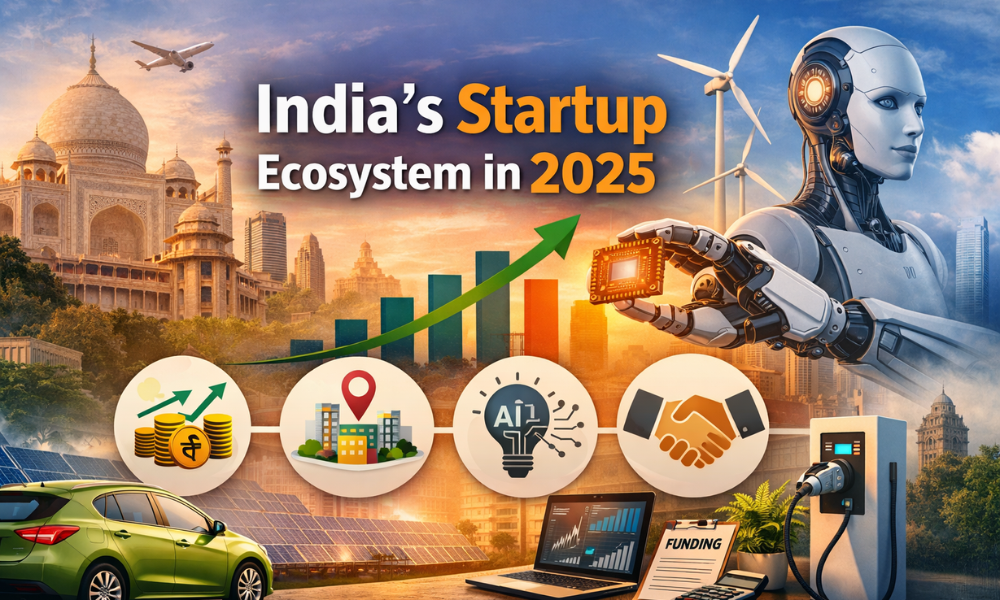
Artificial intelligence (AI), deep-tech, and climate startups play a significant role in shaping India’s startup ecosystem within 2025. AI technology is being incorporated across various sectors (i.e., healthcare, finance, logistics, and customer service) to create intelligent platform solutions to allow companies to increase their overall operational efficiency and enhance decision-making. Additionally, Indian-based startups focused on developing deep-technology (i.e., robotics, semiconductor designs, and advanced analytics) are attracting long-term capital investment from investors looking to support innovation. The climate-tech industry has recently gained increased importance amongst Indian-based entrepreneurs, with many climate-tech startups focusing on creating electric vehicles (EVs), renewable energy, waste management, and sustainable manufacturing. More importantly, through continued investment and growth of these sectors, climate techs are now considered commercially viable and scalability, rather than solely an experimental interest area for many entrepreneurs. Consequently, due to an increase in investor interest in technology-based solutions to improve real-world problems, there has been a significant increase in innovation that provides both measurable impacts and returns to investors.
Changing Investor Mindsets and Funding Patterns
Investor attitudes and patterns of investment for start-ups in India’s start-up ecosystem have shifted dramatically by 2025. The trend today among our venture capital firms is to be more conservative and to seek out quality over quantity in the investments being made. As a result, the valuations of businesses today are much more realistic than those in the past; hence, there has been an increased focus on how well start-ups define their business models, demonstrate effective leadership, and demonstrate a sustainable growth path. There is also an increased interest in investing in early-stage and sector-specific businesses—specifically, companies that are using AI, SaaS, and climate technology. As governments have created funds and corporations have developed venture capital arms to support innovation, funding will become much more strategic than it was in the past and will support the growth of resilient start-up, rather than simply looking for quick valuations.
Conclusion
India’s startups are expected to be more established, resilient, and have a clear innovation strategy by 2025. Startups are concentrating on building a profitable business, developing technology-based products, and growing sustainably; this is developing a more prepared and thus robust startup ecosystem for the future. The emergence of businesses created outside of major metropolitan areas, and a new set of expectations for would-be investors has also contributed to create a more equal and accessible startup ecosystem. India’s innovators have adapted from being solely focused on scaling their businesses to building sustainable companies that will be able to compete on an international level.