Paytm’s Business Reset: Can Profitability Restore Investor Confidence?
Introduction
Paytm has seen its fair share of challenges as a digital payment company that has grown from a market leader to a struggling listed company. Over the years, the company has seen instances of loss, regulatory challenges, and loss of investor faith. At the moment, the company is finding it challenging to prove its viability as a business enterprise. As a way of addressing the challenges facing the company, Paytm is undertaking a major overhaul.
Reasons Behind the Uncertainty: Understanding How Paytm Lost Its Investor Confidence
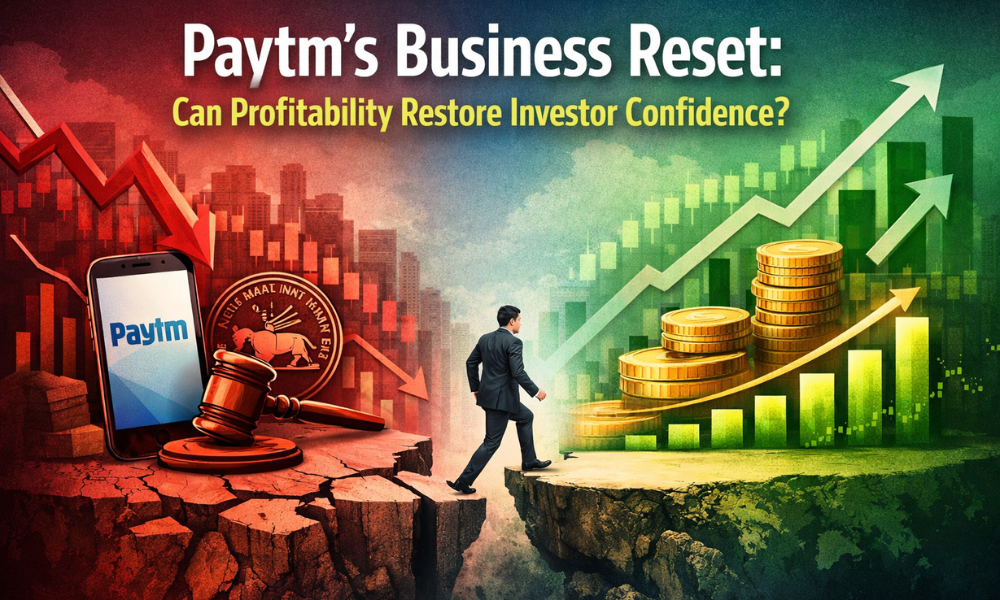
The disillusionment of Paytm shareholders can be understood in the context of how the IPO narrative of the company’s growth, prior to listing, differed from the actual status after listing. For over a decade, Paytm has focused heavily on acquiring customers to maximize growth, though at a fundamental cost of sustaining losses as a company. After the IPO, Paytm saw a sharp increase in interest rates from shareholders in terms of cash flows and profitability, clearly highlighting Paytm’s weak financial model as a company. This took a further dangerous turn as a series of regulations from the Reserve Bank of India regarding Paytm Payments Bank raised significant concerns regarding issues of compliance, corporate governance, and operations. This led to a disturbance in Paytm’s services, creating a haziness regarding the company’s entire financial model. This has caused a sharp decline in Paytm’s stock prices, raising multiple concerns regarding how a company has moved from a fintech growth strategy to a risky model in the eyes of many shareholders.
Cost Efficient Strategic Reorganization of Paytm
Due to the mounting pressure on Paytm, the company has started an integral strategic reorganization to develop a more cost efficient and streamlined business structure. As part of this effort, Paytm has put into place major cost cutting initiatives such as a reduction in head count, a decrease in marketing spend and an exit of low-margin/non-core business areas. This is a dramatic shift from the company’s previous position of “grow at all costs” to management concentrating on refining internal processes and increasing productivity throughout the organization. With increased efforts to minimize spending and simplify their operating structure, Paytm plans to decrease cash burn and extend their financial runway. This reorganization suggests that the company has reached a more mature phase in their development and is placing more emphasis on sustainability than on growth. Nevertheless, as Paytm proceeds through this transition in developing them into a more cost-efficient organization, sustaining their growth momentum is likely to be one of their major challenges in implementing their turnaround strategy through increased cost efficiency.

Can Core Businesses help Paytm drive Sustainable Earnings? The Profitability Push
Paytm’s renewed concentration on developing Profitability relies heavily on developing their core businesses that generate Revenue. i.e. (Payments, Merchant Services and Loans, Distribution, Subscription-based). By focusing on the core businesses instead of just growing for growth’s sake, Paytm is looking to develop higher margins on products and to Turn unit economics into Positive Revenue. They are also looking to reduce their exposure to high-risk, high-cost Loans while maintaining Partnerships and Distribution fees derived from Lending. Revenue generated from Merchants using Devices, Software and Value-Added Services is growing into a Stable Revenue Stream. The success of this Profitability Push depends on how well Paytm implements this Strategy, the availability of Regulatory Clarity and being able to Balance Revenue Growth with Risk Management. If Paytm can successfully show Predictable Earnings derived from their Core Operations, it will ultimately change the way Investors View Paytm as a Company.
Investor Outlook Ahead: What Will It Take to Win Back the Market’s Trust?
To regain investor trust, Paytm must do more than improve profitability in the short term; it needs to prove to investors that it has a track record of delivering consistent earnings through regulatory compliance and good corporate governance. To accomplish this, Paytm must clearly communicate its long-term plans and how it intends to control risk. It is also essential for Paytm to show that it is increasing cash flow and will generate free cash flow soon, as these will be the best ways to convince investors to return to Paytm. Additionally, institutions require stability, predictability and accountability; therefore, rebuilding credibility is essential for Paytm. Additionally, any regulatory setbacks could jeopardise Paytm’s progress and therefore compliance with regulatory requirements must remain the highest priority. Nevertheless, for Paytm to demonstrate that its recovery in the market is based on a permanent change in its strategy, not simply a temporary reduction in expenses, it must prove that its business reset is not only structural, but also enduring. If Paytm is able to do this, profitability will serve as the primary basis for renewing trust and long-term support among its investors.
Conclusion
Paytm’s business reset is a critical inflection point in its post-IPO journey. Shifting from aggressive expansion to cost discipline, compliance, and profitability, the company is addressing the very reasons that once eroded investor confidence. But it will be consistency and not mere intent that will restore faith. Sustainable earnings, regulatory stability, and transparent execution will be far more important than short-term improvements. If Paytm can deliver predictable profits while sustaining governance discipline, it is in a position to reposition itself as a credible long-term fintech player. Until then, investor sentiment will likely remain cautious and closely track whether this reset translates into durable financial performance.