The Future Professions That Don’t Exist Yet (But Probably Will Soon)
Introduction
There is usually no grand announcement when the future arrives; typically it comes through gradual shifts in daily activities, technological changes, and emerging challenges that people face without a clear plan for addressing them. In today’s accelerating advancement of the world and technology, types of jobs that were once given little thought or were unknown may become frequent. In fact, as we gain experience with these new types of roles, there will likely be little difference in how we think about the job of the future compared to the current ones. In the meantime, many of these types of roles are slowly developing and beginning to take form behind the scenes, and they will likely begin to shape the way we approach and interact with our work, the ways we connect with others, and the mannerisms we respond to and adapt to a rapidly changing world.
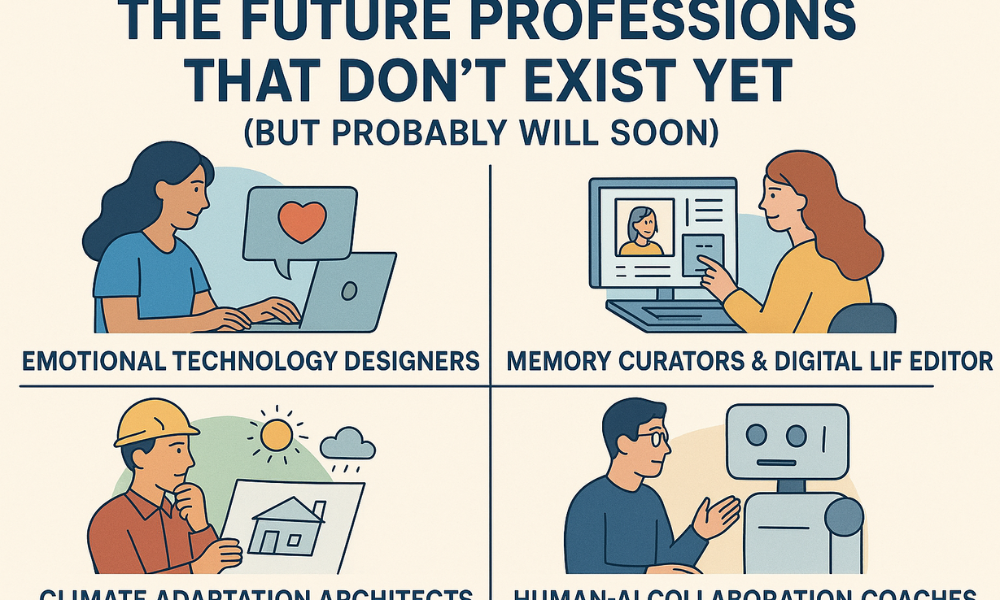
Emotional Technology Designers
As technology gets more personal, we are going to need people who know how to create empathy through these digital tools in addition to writing the code behind them. The core focus of the Emotional Technology Designer role is to create ways for digital tools to be able to respond to the moods, levels of stress, and other emotional signals of the user. Think about an application as if it were there to help you calm down, or a Virtual Reality (VR) space that would actually adapt your environment based on your energy level, or an AI assistant that can change its tone of communication according to the room’s atmosphere. The Emotional Technology Designer will not only build features but will also build emotional experiences. To do so, they will utilize Psychology in the design, and together with AI, create technologies that are more humane, helpful, and natural to use. As we spend more time interacting with technology than with other humans, this role will promote empathy and connection through technology.
Digital Life Editors & Memory Curators
As we shift more and more toward an online existence, we continue to generate an enormous amount of digital content each day including photos, messages, audio recordings, written documents, and millions of random images we may or may not recall taking. Digital Life Editors/Memorial Curators assist individuals in sorting through their day’s worth of digital clutter and transforming it into something meaningful. A Digital Life Editor may create an individual’s “Life Archive” from the numerous pieces of digital content the individual has collected throughout their lifetime. The Life Archive is a collection of an individual’s digital memories/archives, his/her digital life, as well as random screenshots and/or photos taken during the individual’s life. Other services offered by Digital Life Editors/Memorial Curators may include providing a personalized time line reflecting an individual’s development and identity; deleting unnecessary digital memories; and preparing to create an individual’s “Digital Legacy,” an archive that may be placed on a website, social media network, or other platform containing an individualized representation of an individual’s life. As digital platforms continue to grow and the capability to store an endless supply of digital content increases, maintaining our digital lives will soon be just as critical as maintaining our physical surroundings. As Digital Life Editors assist individuals in determining what to maintain, what to discard, and what accurately reflects his/her identity, Digital Life Editors will continue to provide guidance.
Architects that Adapt to Climate Change
As the world’s climate continues to transform, several established designs for housing, workplaces and cities will not suffice. Therefore, Climate Adaptation Architects will build sustainable structure; i.e. houses/workplaces, etc., that can withstand/honor these climate changing events.
Additionally, the Climate Adaptation Architects will continue to think outside the box, with innovative features for housing/workplace systems that include features suited for hot temperatures, extreme weather events such as storms and floods, water conservation, etc.
They will design structures such as floating neighbourhoods, heat resistant structures, and modular housing units that are easily moveable as the environment changes. Furthermore, they will partner with climate experts, engineers, and environmental psychologists to develop designs that will allow us to maintain emotional comfort even as we experience climate change.
The ultimate goal is to create a type of structure that will provide safety, stability and support for our communities as we continue to experience these dramatic changes to our planet. In turn, Climate Adaptation Architects will be the architects of survival and hope for our future.
Human-AI Collaboration Coaches
As AI becomes an everyday partner in almost every industry and workforce, humans will require support in how to effectively and ethically collaborate with it. Humans will work with Human-AI Collaboration Coaches, who will assist individuals and companies in determining when to use AI and when to override it by combining human intuition and machine accuracy. They will also teach teams how to utilise AI creatively while avoiding becoming too dependent on it; they will guide teams through the process of learning how to communicate with various types of AI tools. In addition, Human-AI Collaboration Coaches will teach and encourage teams to draw the lines of ethics around the use of AI, ensuring that individuals maintain authority over the work they do and do not relinquish this authority to algorithms. Coaches will ensure that the human aspect of work remains strong in a future filled with automated systems. Coaches will empower people to feel skilled, confident, and empowered by the increase of AI rather than feel threatened or overshadowed by it.
Conclusion
The future of work is not just about new tools; it is also about creating ‘people’ who know how to utilize these tools effectively and productively. Emerging roles demonstrate the rapid pace at which society evolves and will place greater importance on creativity, empathy, and adaptability than ever before. The jobs we envision now may ultimately help define the future of society and our planet.