The Hidden Mathematics Behind Our Daily Routines
Introduction
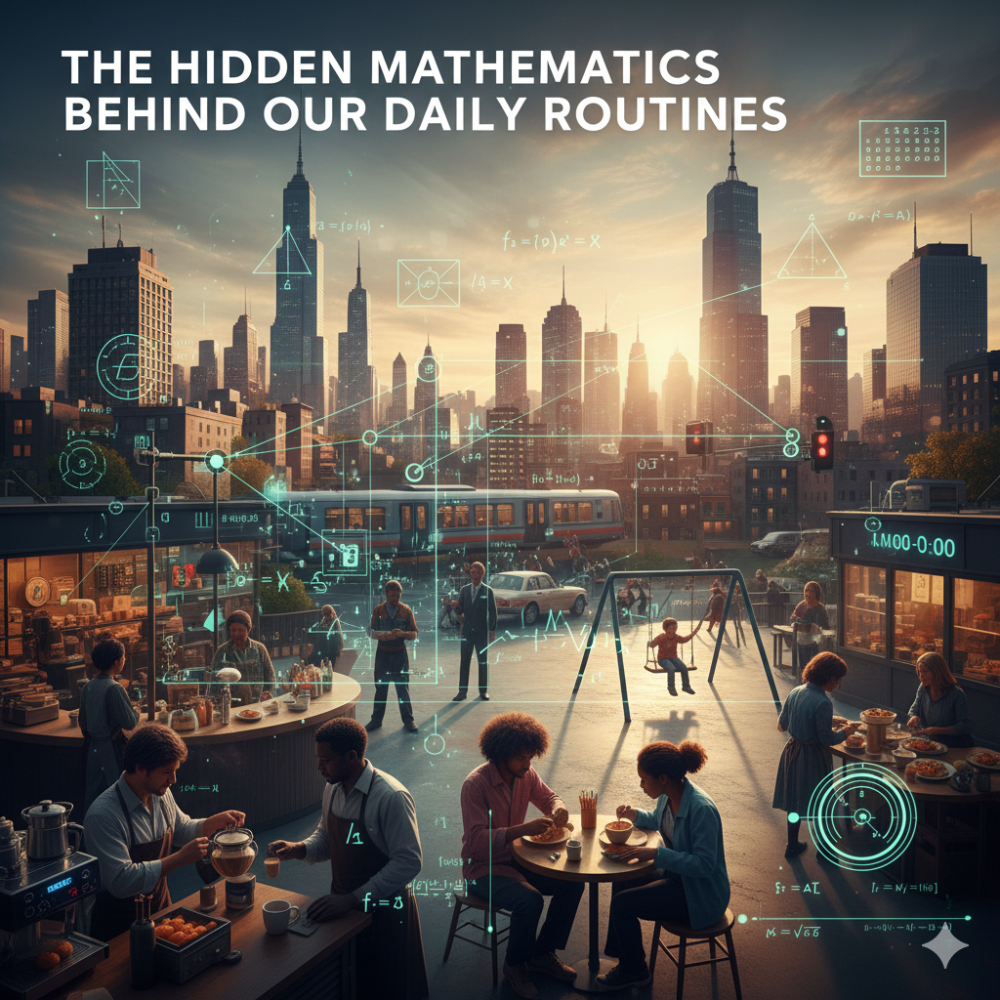
Even though our daily lives seem very simple and regular, they actually operate on highly organized, underlying patterns that we are often unaware of. Without our awareness, numbers control us in determining how we behave, the way we move about place, and the way we live our lives. By calculating various factors (such as risk), sequencing events, and optimizing our time, we are often unaware of all the underlying calculations we have gone through to arrive at our conclusions about how to move around and plan our activities. In other words, all the mathematics behind our everyday activities will be revealed through this blog.
The Invisible Geometry of Movement in Everyday Life
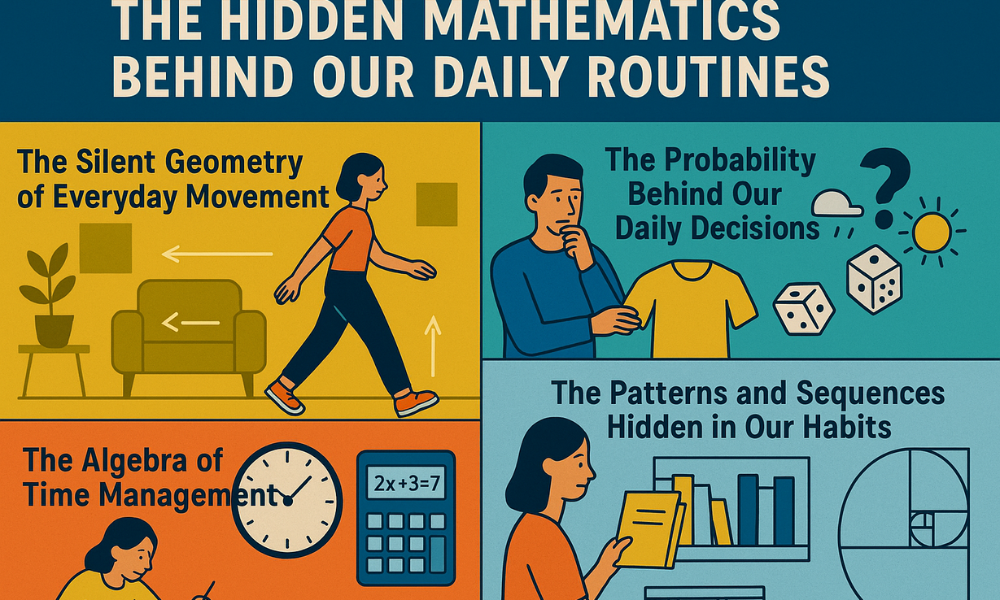
All day long, you and I, without realizing it, follow the rules of geometry every time we walk through our homes. As we walk from point A to B, we intuitively navigate the most direct or open paths. When arranging furniture in our homes, we often select arrangements that make us feel “balanced.” That is, we arrange pieces in such a way that there is symmetry, correct spacing, and/or a proper distribution of shapes throughout the space. This idea can also apply to something as simple as putting your cell phone down on a table; generally speaking, we center our phones, orient them toward us, or select positions for them that make them feel more comfortable to grab again. Additionally, all of your Life Experiences—crossing a busy street or navigating around people at a party or picking a seat—require a combination of silent calculations about distance and direction before you even begin the process of moving towards your destination. Therefore, while we may not consciously think about geometry every day, it is a major influence throughout our entire daily experiences.
How Decisions Are Affected by the Odds
Every choice we make—big or small—is really about probability. For example, when you’re getting dressed in the morning, you may think about how likely it’ll rain or how cold you might be, but also if your meeting will require you to wear something professional. The same holds true when you’re driving to work. Your brain will quickly determine the probability of hitting traffic, being delayed, or getting stuck because you’ve been through these situations before. Even when you order food, you’re making a decision based on probability. You may ask yourself, “Will this taste good?” or, “Will I regret this?” Such small probability assessments give us an idea of how to prepare for the day ahead and keep us more confident as we go about our daily lives. Although we usually think of probability as something from a math class, it actually influences our everyday decisions long before we leave our bed.
The Algebra of Time Management
Managing one’s time may also be seen as solving an equation by balancing tasks (that is) changing your ‘variables’ to arrive at the best possible results. When planning out one’s morning, you often mentally determine the total time needed for each task, only to find that you need to rearrange the elements of your equation due to unexpected events in your day. Examples of this may be if you are running late and decide to eliminate or shorten some of the ‘variables’ such as eating breakfast or scrolling through Facebook/Twitter/Instagram? Because there may be multiple things vying for your attention at the same time feel much like having to assign different values within an equation based upon their importance. Additionally, in order to make a fully informed decision about whether or not you will complete a project prior to a deadline, you will have to mentally add or subtract any additional ‘variables’ you may experience between now and your deadline. Time management comes naturally to us as we do it all day long without putting it into writing but within it are constant rearranging, balancing and simplifying of all possible scenarios that one could experience over time-just like what you learned in algebra.
The patterns and sequences in our lives
We have patterns in all of our habits, even though we may not be conscious of them. For instance, most people have a morning routine which usually has the same sequence of events, such as getting up, looking at their mobile phone (if they have one), brushing their teeth, preparing to get dressed, eating breakfast, etc., creating a series of sequences that repeat themselves over and over again. We have developed a predictable rhythm within these first 2 hours of the day, i.e. waking, using the phone, brushing teeth, getting ready, eating. These patterns help the brain save resources, in this case, energy by converting what we do that is the same as before into automatic.
During the day, we also follow patterns and sequences of these smaller sequences. For example, the way we check apps on our mobile devices, our workspace set-up, or preparing for going to bed, all produce performance characteristics that mirror the performance of mathematical sequences.
Knowing about these patterns will enable an individual to either improve their performance through positive patterns of behaviour or break poor behaviour patterns that do not yield positive results.
Thus, it is important to understand our habits; they are not random! They are comprised of loops that have been developed through experience, comfort, and repetition.
Conclusion
Our daily activities may be mundane, however they are governed by an invisible mathematical underpinning. How we conduct our lives physically, make decisions, create plans and form regular patterns all demonstrate how numbers influence us; yet these effects are usually not obvious until we start seeing them. The more you observe these numerical patterns in your daily life, the more you will see how much thought went into making even trivial occurrences feel like something more purposeful, meaningful and intentional. Once you learn about “hidden” mathematics, your perception of everyday life will shift from being a technical pursuit to understanding the natural structural beauty behind the chaos of everyday living.