The Questions We Answer Without Being Asked
Introduction
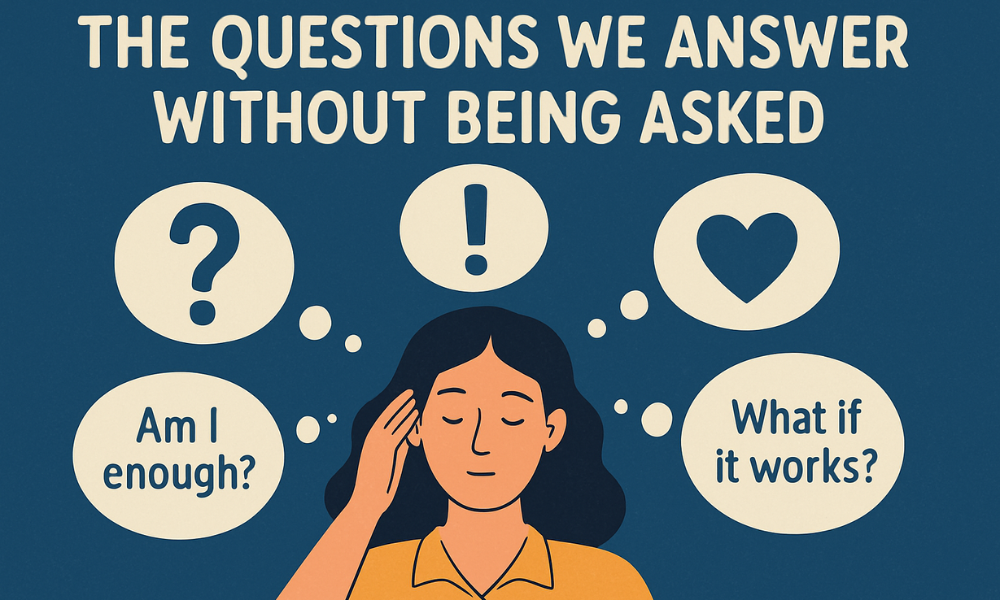
Every once in a while, we formulate answers for questions that have not been raised directly to us. A question that we silently carry within ourselves and that reflects past experiences and suppressed feelings. Where fear is concerned, we may never voice our fears openly, and the same goes for our hopes; therefore, our answers to these questions remain hidden from us. The silent questions and answers are often told through our actions, speech, body language in a room, and may often go unnoticed by us. By exploring the silent questions within us and those answers, we gain insight into ourselves.
Feelings Of Acting ‘On The Inside’ Before Speaking ‘On The Outside’
Many of us conduct silent dialogues in our minds on a regular basis, sometimes to the point that we do not even realise that we have entered into this type of dialogue. By having ‘silent dialogues’ we are often preparing for a certain outcome; when we think we know how to react to an unexpected situation, or even when we think we know exactly how someone would react. Our silent dialogues often arise out of a need to express our thoughts and emotions to another person, and at the same time protecting ourselves from harm. In the case of silent dialogues, we can often feel and see a combination of both the person’s emotions and feelings, while making sense of our own emotions and feelings without necessarily having spoken to another person about them. Understanding these silent dialogues gives us insight into the extent of our emotional lives, and developing this understanding creates a better opportunity to manage our emotional lives.
The Fear-Based Questions We Preemptively Answer
Before anyone else can ask the question for us, he begins by creating an answer for himself based solely on a fear of never answering that question. We create this fear for ourselves long before anyone else forms any idea or thought about it. The response to that fear is often to withdraw, continually explain ourselves, be overly apologetic, or miss out on the chance to take advantage of an opportunity. We constantly form and reinforce a defensive position against assumed criticism, whether that is geared toward criticism that is directed towards ourselves or for criticism that is directed toward someone else. The toughest part is that these are also very real questions to us; they are created from years of carrying around the wounds we received in past experiences and the insecurities that arose because of those experiences. By getting in touch with our fear-based response, we can reduce and overcome the grip that these responses have on us, and we can fight back against the story they have created for us. It is one small but big step toward going from self-doubt to developing an understanding of ourselves.

Questions Based on Hope
For many of us, some of our unasked questions are filled with hope instead of fear, although most of our unasked questions are fear driven. In addition to the louder internal questions such as “What am I afraid of?” or “Am I going to make this work?”, there is also the softer internal questions such as “What if this works?” and “What if I am capable of greater things?” When fear and hope come together it produces a strong desire to act with courage; this is how the quieter, softer internal hope question aids in our desire for courage.
The hope driven question provides a means of determining whether we want to try something new, or reach out to another person for help, or take a leap of faith, or trust ourselves a bit more than yesterday. Even at times when we do not know how to make the next step, the response to this internal voice provides reassurance that there are opportunities beyond what we can see. At these moments, the soft voice pushes us to stay on course. The process of identifying and listening to the internal voice of hope leads to the enhancement of our capacity to be resilient to life challenges, and furthermore, it leads to a growing understanding of the quiet but optimistic mindset that all human beings possess, regardless of what they fear.
The Emotional Weight of Invisible Conversations
Invisible conversations influence the decisions we make in our daily lives The emotional weight of these invisible conversations causes us to be defensive about things in advance / prior to things actually occurring, or to feel hopeful towards things that have yet to happen (and may ever) because of these conversations we carried inside ourselves. However, we often misunderstand how these conversations affect our thoughts, emotions, etc., by reacting based upon what was said rather than the current moment. By becoming more aware of these invisible conversations and the effects they have, we become much more aware of ourselves, and can respond to and communicate much more clearly and sincerely with others. We can do this, by simply taking a moment or two to breathe and gather ourselves before responding.
Conclusion
Ultimately, our thoughts are indicative of our deepest fears, hopes, growth, and the parts of ourselves that we are still learning about. The things we think about can have a greater impact on the way we navigate the world than our spoken words do. By first witnessing and recognizing the thoughts that go through our heads, we learn to feel more clearly and compassionately about emotions (ours and others). Perhaps this is the beginning of true growth, by hearing those parts of ourselves that we never knew were present.