What Daily Life Would Look Like If People Could See Each Other’s Thoughts for 5 Seconds a Day
Introduction
People often misinterpret others not due to them being dishonest, but because we cannot perceive the emotions they are experiencing through their minds. Imagine, then, an existence where every person’s internal dialogues had five seconds of exposure each day, free from interference, and unrehearsed. Such situations would drastically modify how humans talked to one another, how we approached one another, how we faked our feelings, and ultimately how we communicated and had relationships with other human beings through our lies and deceit. Instead of being based on outward appearances and actions, our day-to-day realities would be founded on that which we can no longer keep hidden.
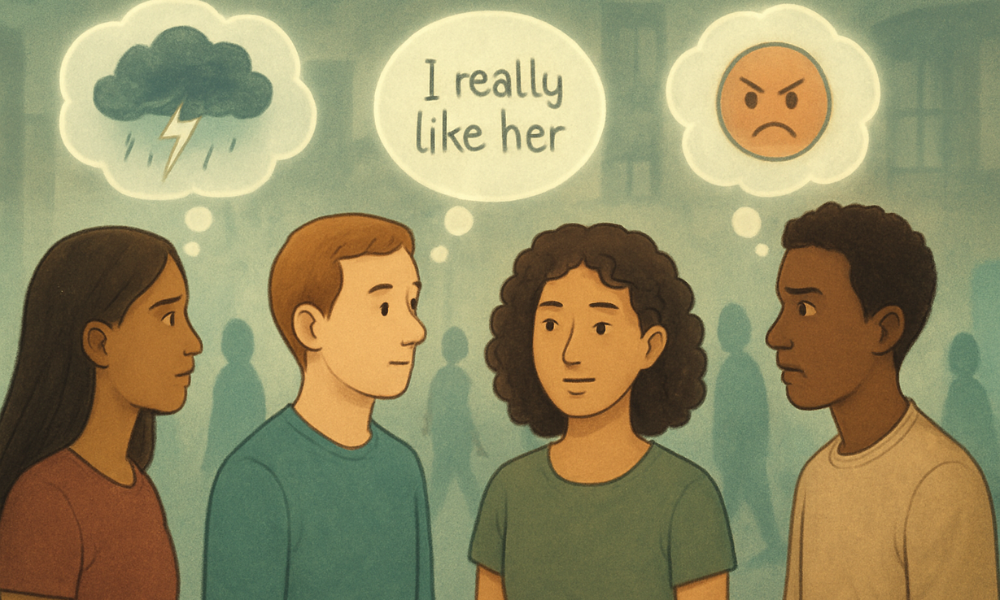
Transparent Minds Indicate a New Standard
If everyone had 5 seconds of inner thoughts displayed online daily (like what is done today), people would adapt very quickly with social norms. Much in the same way we learned how to act in regards to our online posting behaviour; we would have to learn how to act within our own thought processes. Many individuals could potentially practice “mental neutrality,” attempting to maintain mental calm during the time frame leading up to a public mental disclosure. Some of the locations where this activity is taking place may even have a standard moment of silence prior to the reveal in order to not misinterpret others’ thoughts. Certain individuals would likely take a very casual approach, while others may strive to maintain hyper-awareness of themselves out of a fear of exposing feelings of anger, jealousy, or insecurity. As time went on, society would adjust itself to create a new method of politeness in which we would not judge someone based on their mind’s 5 seconds because we also understand that our own mind may not be so calm.
The Honesty of Honest Relationships
The 5 seconds would create the most honest relationships possible. Couples will be able to view the truth in “I’m fine” and see what is really in the heart. Friends would be able to see their other friends’ hidden insecurities or admiration for them and would break through a lifetime of emotional distance with each other within an instant. However, there is a downside to honesty. Some candid relationships will break as people are not ready to expose the things they have kept silent, and it can be done without even intending to. On the other hand, many of the bonds and connections created through honesty will become stronger. People will be more aware of feelings that are unable to be put into words. For example, families struggling with poor communication skills may heal as a result of love, worry, or pride being shared in silence. Instead of having to read each other’s minds, we would have a small piece of insight into one another’s true emotional lives, which would enhance all relationships and the feelings that have been misinterpreted. Trust would also take a new turn in the direction of open communication.

The Loss of Privacy is Causing Hidden Stress on Our Mental Health
Although this period lasts for a mere five seconds, the anxiety associated with having one’s innermost thoughts laid bare is capable of impacting someone’s day. Some people may find their thoughts becoming rehearsed, like the way one would prepare for a speech, as a means of protecting their own “mental cleanliness”, i.e., keeping their thoughts clear and uncontaminated by any outside influence, while others may develop a ritual by engaging in activities such as deep-breathing, meditation, or even creating distractions for themselves. For example, if a negative thought occurs regarding a colleague or friend, even though the thought was unintentional, feelings of guilt can occur. Over time, this type of experience can create an implicit expectation for individuals to achieve something akin to “mental perfection”, similar to how many individuals feel pressure to maintain an “ideal appearance” on the internet. Thus, as a result of losing mental privacy, many people will likely become anxious and self-conscious about everything they think. However, ironically, the loss of mental privacy will allow many people to become more compassionate and forgiving of themselves, and therefore they will come to understand that every individual on the planet has wild and crazy jumbles of thoughts they cannot control.
Creativity, Problem-Solving, and Empathy: Transformed Through Thought Exposure
Although thought exposure may appear intimidating, it also has the potential to provide significant advantages. For instance, in a brainstorming meeting, if one participant has an unrefined and incomplete concept, they may be able to share it with the group and develop new paths or alternatives from that single thought. Likewise, through exposure to the thoughts of their teachers, students may develop an empathetic understanding of a teacher’s level of enthusiasm or level of apprehension for teaching a topic; therefore, their connection with their teacher may become more humanized. Similarly, when an employee is exposed to another employee’s thoughts, he/she may perceive that there is a difficult circumstance or task at hand that is overwhelming or difficult to deal with, allowing employees to support rather than critique one another behind closed doors. Emotion can be expressed more openly as a result of such thought exposure, thus generating empathy for one another and recognizing that every individual faces challenge that are not visible to the naked eye. Furthermore, writers, artists, and musicians may use this thought exposure daily to provide insight into the complexities of human existence, the thoughtful and honest exploration of identity, vulnerability, and truth, and to create new works of art. In conclusion, through this understanding of the complexity, fragility, and unique nature of the human experience, we can begin to make a more compassionate society.
Conclusion
For a brief moment, thoughts made manifest constitute a new and unavoidable way of learning how to be honest in today’s society. This instant clarity enables us to see how alike our buried apprehensions, longings and affects are in humanity.