Why We Trust Strangers Online More Than People We Know
Introduction
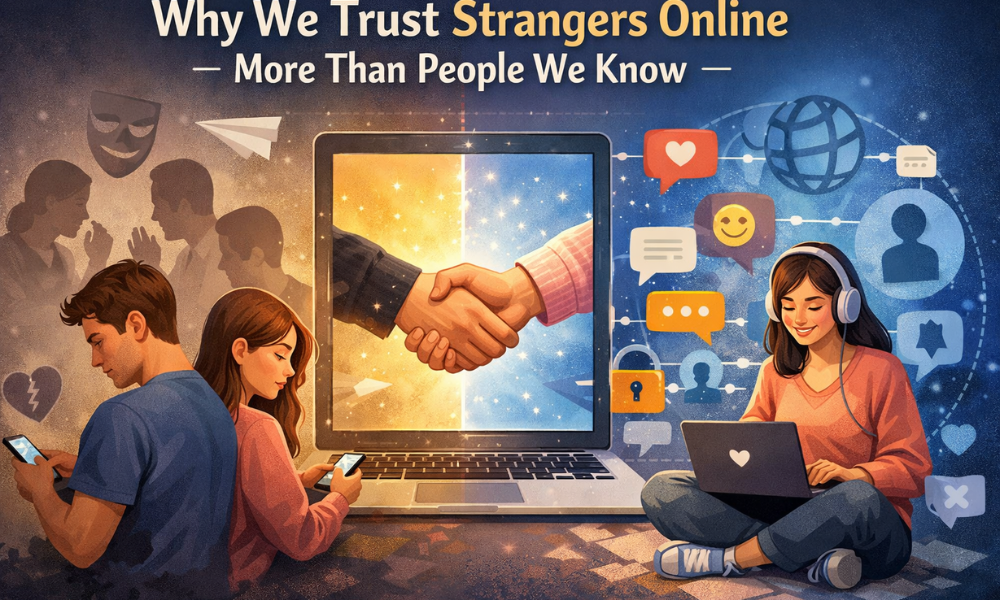
When you think about it, it seems odd that a random person on the Internet may be much more approachable than a friend of many years’ standing. However, I believe this statement contains some truth; we talk online with relative freedom, as there are usually no inhibitions, no fears of what others think, and we do not worry about being misinterpreted. People will reveal things about themselves to an anonymous poster or via Direct Messaging (DM) or comment section that they would never verbally disclose to a close friend in person. This growth in our willingness to trust others online demonstrates how technology continues to shape our relationships.
The Comfort of Anonymity and Reduced Judgment
One of the biggest reasons we trust strangers online is due to anonymity. When our real name, face, and history are concealed, the fear of judgment quietly fades away. We don’t bother if someone is going to bring up our past, misunderstand our tone forever, or label us based on one vulnerable moment. Online, especially in the case of forums or social media, we feel free to say what we actually think or feel. Strangers know nothing of our family, flaws, or failures, and that strangely ends up being comforting. There is less pressure to impress or protect an image. We could just be forthright. In this absence of long-term consequences, emotional expression does feel much safer. In real life, people who know us might remember our words, question us later, or see us differently. Online strangers exist only with regard to that moment of sharing. That temporary connection forms a safe space in which vulnerability feels lighter, and trust comes easier.
Identities Cured and the Illusion of Honesty
Online spaces offer a venue for people to present carefully shaped versions of themselves. We choose our words, delete what feels wrong, and polish what we share. For that reason, interactions can often feel more considerate and emotionally astute. When a stranger responds with empathy or insight, it feels genuine-even if it’s filtered. This creates an illusion of honesty that feels comforting. By comparison, the people we actually know see us in all our unedited moments, including all the awkward and messy ones. That familiarity can make conversations harder. Online, the distance lets people listen better and respond more kindly. We also assume that strangers have no reason to lie to us, personally, which makes us trust them. Their advice or comfort feels impartial. Even though these identities are curated, the emotions shared are often real. That combination of emotional truth and controlled expression makes online trust feel surprisingly robust.

Emotional Distance Creates a Sense of Control
Trust is increased through elements of control which are present when using technology to communicate. Communication over the internet allows individuals to maintain control by choosing when to respond, the degree of detail in the responses they provide, and when to stop or leave the conversation. When communicating through the Internet it does not place pressure on a person to immediately respond to an individual or to fill an awkward silence with conversation like in face-to-face communications. Because of the lack of proximity between individuals communicating electronically, an individual can be vulnerable without fear of rebuke. If an individual is feeling uncomfortable or the conversation is turning negative, should a person log off of the chat rather than continue in an uncomfortable situation, this eliminates the need for going through the emotional pain of hearing criticism in real-time. Internet communication provides an opportunity to think through text-based messages and to put protections in place to allow individuals to develop confidence over time so they can communicate with less fear of being hurt or invalidated. The development of confidence results in the ability to communicate with more detail because individuals feel less vulnerable when using the Internet to communicate with others. Over time, the trust that has developed becomes so solidified that individuals feel safe communicating with strangers due to the knowledge that they will be listened to with respect and will not be forced to communicate more than they are comfortable with.
The Connections and Relationships We Share Through Our Experiences Make Us Feel Connected
When we have a shared experience, it is easier for us to establish our trust for each other. There are many different communities on the internet made up of people with similar life experiences, including those related to grief, anxiety, career-related issues, and Broken Relationships. When someone shares with us what they experienced and we relate to them, we automatically have a sense of camaraderie and support, even if we have never met before. Online, relationships are formed based on common experiences, while in person many times our relationships can be impacted by differences in our experiences. When an individual shares their experience with us and we can relate to that, we are much more likely to trust that person and feel close to them immediately. It does not need to take a long time to build that connection – it occurs very quickly, even without a lot of conversations. Family and friends may still love us, but at times they cannot offer us the understanding that someone we do not know may provide. Emotional alignment is the key to faster development of trust than previously attained through years of casual discussion. We may not have a complete picture of an individual’s life history, but we can see and appreciate how we are alike and understand one another’s feelings and emotions in the present moment. This is often enough to build trust, and we sometimes do not need anything more to do so.
Conclusion
While trusting people you cannot see is awkward, it is also an expression of the desire to feel safe when asking for help or advice. People find that the internet provides an anonymous environment where they feel emotionally safe, allowing them to express, share, and connect with others. The connections formed through social media can be fleeting. However, the emotions felt in the process of a connection are very real. The act of trusting someone you have never met in person, therefore, is not based on distance, but on being able to be themselves honestly.