AI Will Now Run Directly on Laptops: Meta Launches ‘Muse Glimmer’ Without the Need for Data Centers
Introduction
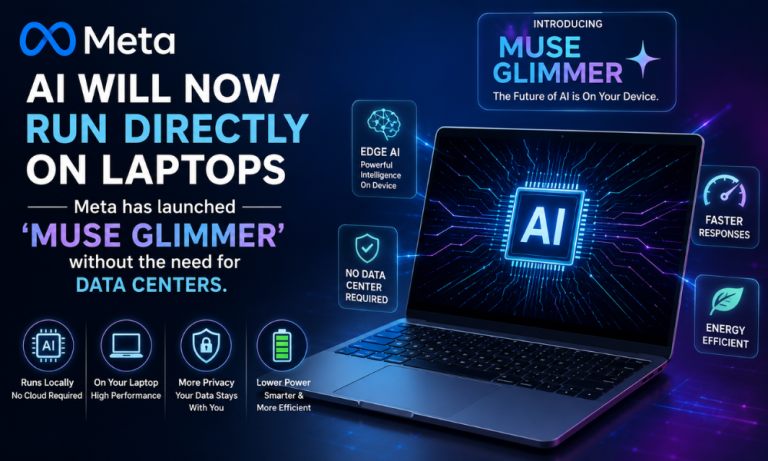
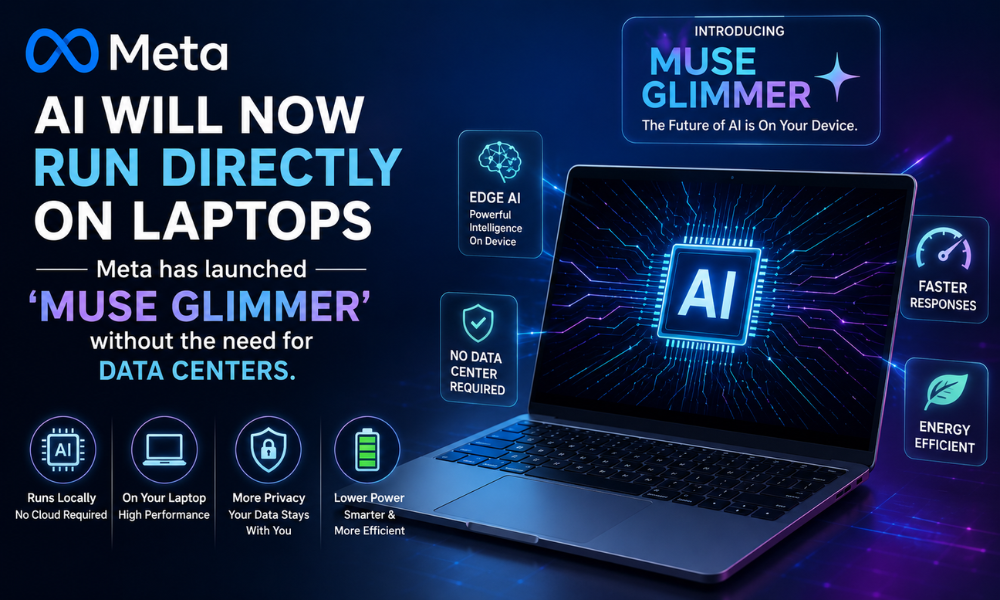
California, In a move that could reshape how everyday people interact with artificial intelligence, Meta has introduced a new compact AI model called Muse Glimmer, built as part of the company’s ongoing open-weight strategy for the AI sector. Unlike most modern AI systems that depend heavily on massive data centers and cloud infrastructure, Muse Glimmer has been engineered to run directly on consumer-grade hardware — including everyday laptops — without requiring a constant connection to remote servers.
A Shift Away From the Cloud
For the past several years, the dominant model for deploying advanced AI has relied on enormous data centers packed with specialized processors, consuming vast amounts of electricity and requiring users to send their queries over the internet to distant servers. This arrangement has worked well for powering large-scale AI systems, but it comes with well-known trade-offs: noticeable latency between a request and a response, ongoing infrastructure costs that get passed on to users, and persistent concerns about how personal data is stored, processed, and potentially exposed once it leaves a person’s own device.
Muse Glimmer is designed to sidestep these issues entirely. According to reports, the model can run on a standard consumer laptop — the kind an average person might already own — using computing power comparable to what’s available in mainstream consumer-grade GPUs. This means the AI no longer needs to “phone home” to a data center every time it’s asked to perform a task. Instead, the intelligence lives locally, on the same machine the user is working on.
Built Through Distillation
At the heart of Muse Glimmer is a technique known as distillation, a process by which a smaller, more efficient model is trained to replicate much of the capability of a much larger one. In this case, Meta reportedly built Muse Glimmer using knowledge distilled from its larger Muse Spark model family. The result is a compact model with an estimated 30 billion parameters — a fraction of the size of many flagship AI systems, yet still substantial enough to handle a wide range of demanding tasks.
The purpose of this approach wasn’t simply to shrink an existing model for the sake of efficiency. Meta has indicated that Muse Glimmer isn’t intended merely to answer questions or hold conversations. Its broader goal is to support more complex, multi-step work — including coding, planning, and reasoning — the kinds of tasks increasingly associated with autonomous AI agents that can carry out sequences of actions rather than provide a single response.
Designed for Local, Everyday Devices
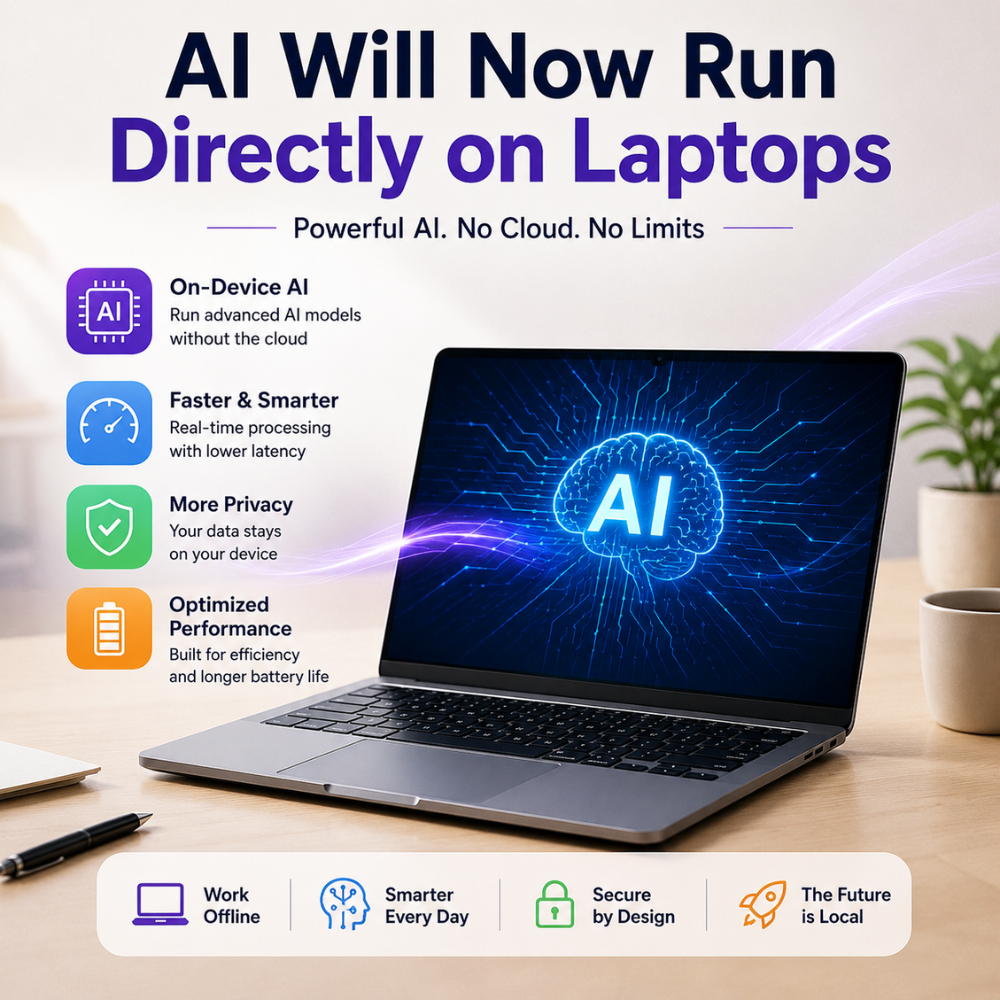
What sets Muse Glimmer apart from many previous AI releases is its explicit focus on local device compatibility. Because the model is compact enough to run on a laptop without external computing support, every task — whether it’s answering a question, writing code, organizing a plan, or working through a logical problem — can, in principle, be handled entirely on the user’s own machine.
This has several practical implications. First, it could meaningfully reduce the response delay that users often experience with cloud-based AI tools, since there’s no round trip to a remote server involved. Second, it could lower the ongoing costs associated with running AI-powered applications at scale, since companies and individuals wouldn’t need to pay for constant cloud compute time. Third — and perhaps most significantly for privacy-conscious users — running AI locally means sensitive information doesn’t necessarily need to leave the device at all, addressing a major point of concern for consumers and organizations wary of sending personal or proprietary data to third-party servers.
Part of a Broader Open-Weight Strategy
The launch of Muse Glimmer also reflects Meta’s continued commitment to an open-weight approach to AI development. Rather than keeping model weights closely guarded, Meta has chosen to make them accessible, a strategy the company has pursued across multiple releases in its AI lineup. Alongside the launch of Muse Glimmer, Meta has reportedly confirmed that its Muse Spark 1.2 model will also be made available in open-weight form, extending this philosophy across more of its product family.
This open approach stands in contrast to fully closed, proprietary AI systems that are only accessible through paid APIs or cloud-based platforms. By releasing model weights, Meta enables developers, researchers, and companies to inspect, adapt, and build on top of Muse Glimmer directly, rather than relying solely on Meta’s own infrastructure to access the technology.
Reduced Dependence on Data Centers and Cloud Computing
Perhaps the most notable claim surrounding this release is the potential reduction in dependence on large-scale data centers and cloud computing altogether. As AI adoption has accelerated globally, so too has the strain on data center capacity, energy consumption, and the broader infrastructure needed to support cloud-based AI services. A model capable of running efficiently on local hardware offers a different path forward — one where not every AI interaction needs to be routed through power-hungry server farms.
This shift, if it scales beyond a single model release, could have ripple effects across the industry. Companies that have invested heavily in cloud AI infrastructure may need to reconsider how much of that investment is strictly necessary if compact, capable models like Muse Glimmer continue to close the performance gap with their much larger counterparts. For consumers, it could mean AI tools that respond faster, cost less to use, and keep more of their personal information under their own control.
Conclusion
While much about the long-term impact of Muse Glimmer remains to be seen, its introduction signals a broader trend in the AI industry: a growing interest in making powerful AI capabilities more portable, efficient, and private. Rather than treating massive scale as the only path to capability, approaches like distillation are allowing companies to compress advanced reasoning, coding, and planning abilities into models small enough to fit on a laptop.
As more companies explore similar strategies, the balance between cloud-based and on-device AI may continue to shift. For now, Meta’s Muse Glimmer represents a concrete step toward a future where meaningful AI capability doesn’t require a data center — just a laptop.
About the Author
A curious mind and love for writing drive Hemangi to create meaningful content.